

Châteauneuf-du-Pape, one of the most prestigious French appellations, is located in the Rhône Valley wine region and holds the distinction of being the first AOC (Appellation d’Origine Contrôlée) region in France. The appellation was discovered by the popes during their residence in Avignon, and the wines earned the title of “papal wines.” Discover why they are worthy of such high esteem—and why they come in distinctive curved bottles—and stop by the Vinolog Wine Shop to get your own.

As always, we’ve selected the best from the region—the Brotte winery. Not only do they own exceptional vineyard sites and follow sustainable practices, but their Châteauneuf-du-Pape wines are among the best-selling in the world. They are especially known for their unique curved bottles, La Fiole, dating back to 1952. Created in collaboration with a renowned glass artist, the design represents old Grenache vines shaped by the powerful Mistral wind.

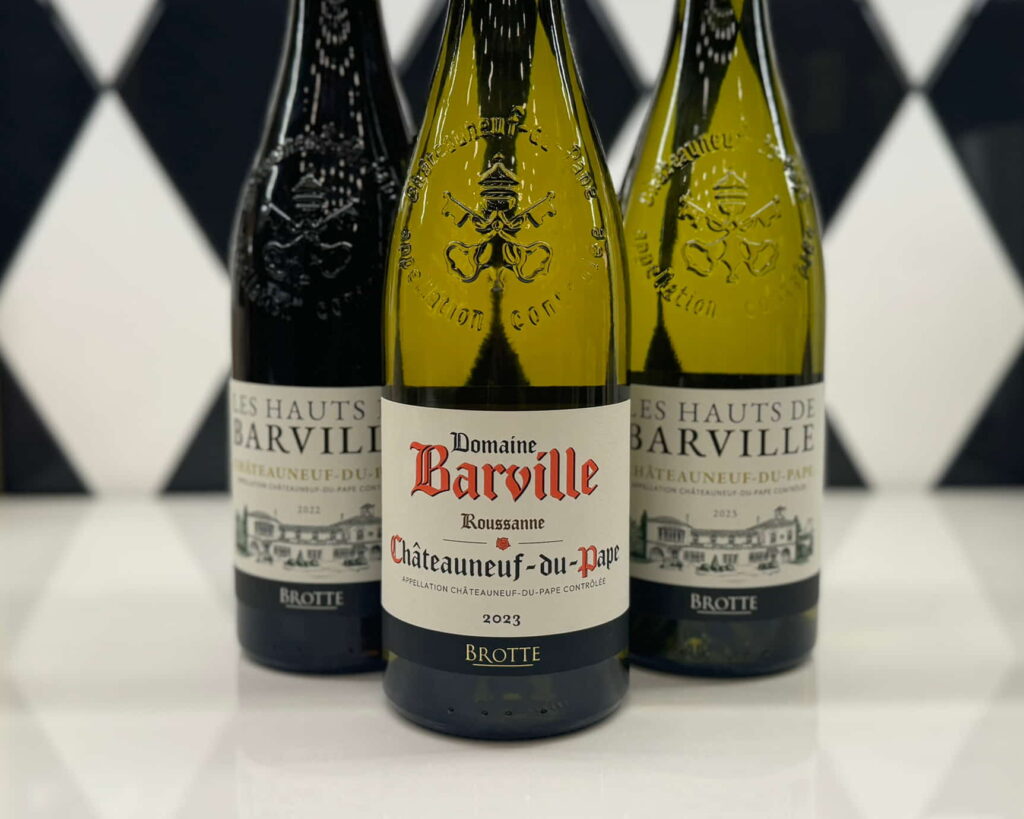
These iconic bottles, like others from the Châteauneuf-du-Pape appellation, feature engraved keys of Saint Peter—a symbol of papal influence. The appellation owes its rise to none other than the popes themselves, who recognized the richness of the terroir during their time in Avignon. Vineyards flourished, the wines gained fame, and they were given the prestigious name Vin du Pape. Legend has it that the popes enjoyed these wines so much that they insisted on them even after returning the papacy to Rome.
We have no doubt you’ll enjoy them as well. The powerful red blends La Fiole du Pape Non Vintage, La Fiole Réserve, and La Fiole Red are truly captivating, while the selection also includes rich rosé and white blends—La Fiole Rosé and Blanc. Alongside the curved bottles, we’ve also selected Barville wines, including a single-varietal, intense Roussanne, as well as red and white blends. You might be wondering why so many blends—the answer lies below.
The Châteauneuf-du-Pape appellation is part of the Rhône Valley wine region in southern France. While the northern Rhône is known for single-varietal wines, the southern Rhône—where Châteauneuf-du-Pape is located—is famous as one of the world’s leading regions for blends. Local winemakers recognized the value of their terroir early on and established strict cultivation and production rules to ensure authenticity and quality.
In 1936, Châteauneuf-du-Pape became the first French appellation within the Appellation d’Origine Contrôlée system. Regulations such as mandatory hand harvesting, careful berry selection, and low yields of just 35 hl/ha (among the lowest in France), along with traditionally low vine density, guarantee exceptional quality.
The appellation covers 3,134 hectares of vineyards, producing an average of 14 million bottles annually. Thirteen grape varieties are permitted, with Grenache dominating nearly 75% of plantings. It is followed by Syrah and Mourvèdre, while other red varieties include Cinsault, Muscardine, Counoise, Terret Noir, and Vaccarèse. White varieties include Grenache Blanc, Clairette, Roussanne, Bourboulenc, and Picardin. Interestingly, 93% of production is red wine, while only 7% is white—and we honestly can’t decide which we prefer.

Photo: winefolly.com
The excellence of these wines lies in their exceptional terroir. The soil is a unique combination of sand, gravel, and red clay, covered with rounded stones known as galets roulés. These stones play a crucial role—absorbing heat during the day and releasing it at night, creating optimal conditions for grape development. The climate is distinctly Mediterranean, with intense sunshine, dry air, and temperatures often reaching 34 to 38°C—comparable to places like Los Angeles. Annual rainfall is relatively low, around 500–600 mm. The key factor, however, is the Mistral wind, which dries the grapes, prevents disease, and helps concentrate sugars. The high sugar levels result in wines with elevated alcohol (minimum 12.5%) and excellent aging potential—up to 20 years.
The production process begins with careful grape selection during harvest. Each berry undergoes rigorous sorting, strictly defined by appellation rules. Whole-cluster fermentation is traditionally preferred, as tannins from the stems contribute to the wine’s structure. This practice is particularly important for wines intended for aging, especially Grenache, which naturally has lower tannin levels. Today, partial destemming is often used to achieve the perfect balance. Vinification traditionally takes place in concrete tanks.
Although AOC regulations do not strictly require organic certification, nearly 30% of Châteauneuf-du-Pape wineries hold EU organic certification. In some cases, appellation rules are even stricter than EU standards. One example of sustainability is cooperation with shepherds—over 600 hectares of vineyards are used as pasture for sheep during winter. From December to February, when the vines are dormant, sheep graze the land, naturally controlling grass growth and enriching the soil. This reduces the need for mechanical soil treatment, helping winemakers optimize their work and improve vineyard sustainability—proof that the French know how to refine processes for everyone’s benefit.

The success of this approach is undeniable. In 2019, Châteauneuf-du-Pape received another important recognition—it was included on UNESCO’s list of France’s intangible cultural heritage.
So, Châteauneuf-du-Pape wines haven’t only charmed popes—they’ve captivated the world. Stop by Vinolog and discover for yourself what this global sensation tastes like!